
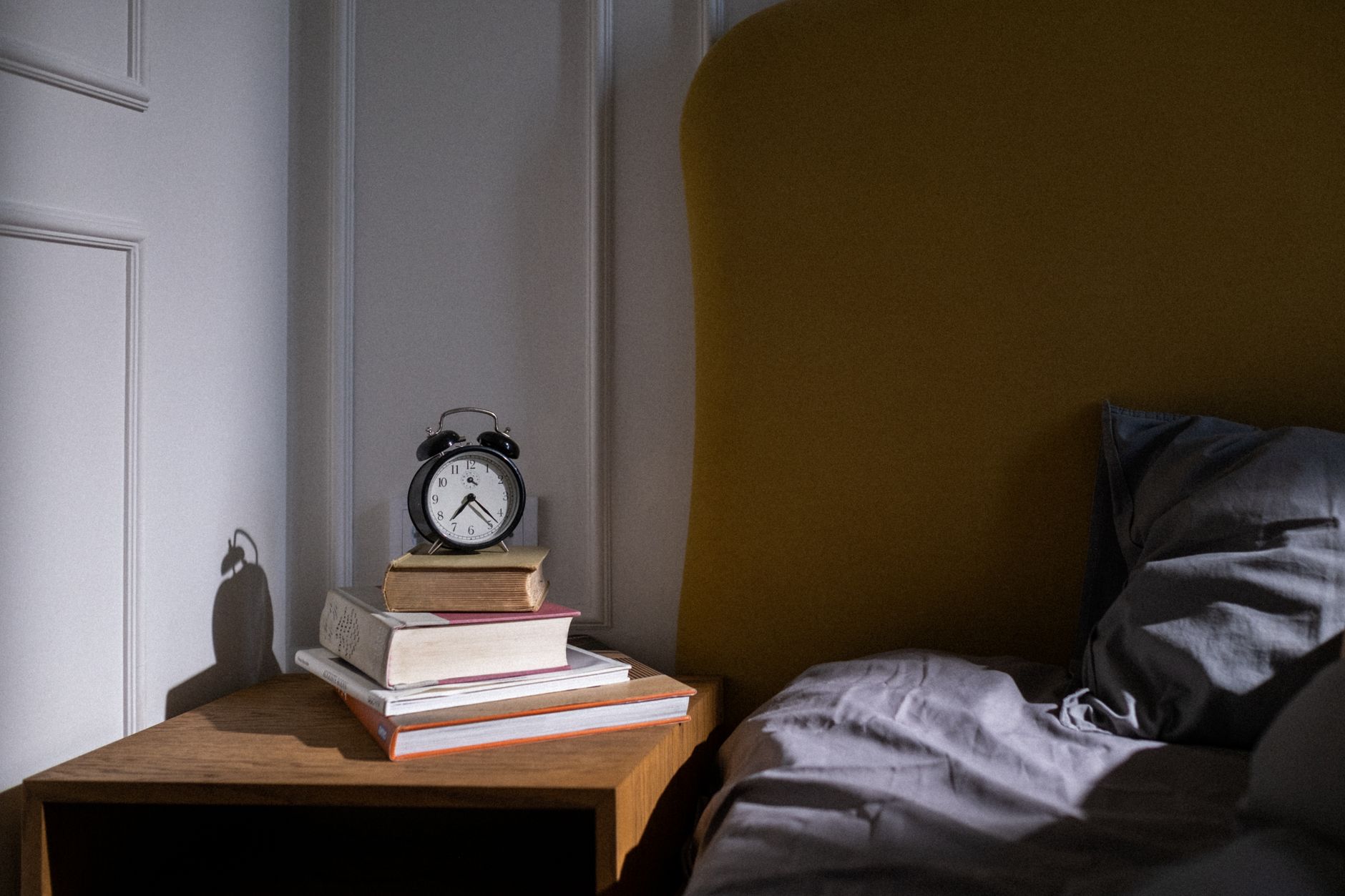
Sometime in the next two weeks, tens of millions of teenagers will set an alarm for an hour their own body chemistry considers the middle of the night, and then keep setting it for a school year. Back-to-school essays are blooming everywhere right now; my colleague Gawon has a wonderful one on the psychology of the season coming later this week. This is the biology version, and I'm writing it because the science here is old, solid, and ignored on an industrial scale. The teenage sleep schedule is not a character flaw. It's chemistry, and the school day is built against it.
The machinery comes first, because nothing else makes sense without it. Every human runs on a circadian clock, a cluster of about twenty thousand neurons behind the eyes that keeps roughly twenty-four-hour time and tells the rest of the body when to do what: hormones, temperature, alertness, digestion. The clock's most famous signal is melatonin, which is a hormone (a chemical messenger that travels in the blood and tells organs what to do). Melatonin rises in the evening, and its rise is the body's announcement that night has started and sleep is now permitted.
I had to read this twice when I first learned it: at puberty, the clock itself shifts. Melatonin starts rising roughly two hours later in adolescents than it does in children or adults. A teenager told to sleep at ten is being asked to fall asleep at what their internal clock honestly registers as eight in the evening, and most bodies simply decline. The same teenager surfacing at noon on Saturday isn't lazy. They're running exactly on time, in a time zone the adult world refuses to recognize.
My first guess about the cause was phones, and it's a reasonable guess, and it's wrong, and the way we know it's wrong is my favorite fact in this whole piece. The delay shows up across cultures, and it even shows up across species. Adolescent rodents stay up later too! A lab mouse doesn't have a phone. The shift is built into adolescent biology itself.
So on one side there's a clock shifted two hours late, and on the other a first bell that rings at seven-something. Adolescents need eight to ten hours of sleep, and large surveys find most get nowhere near that on school nights. The gap, an hour or two every single night for years, is what researchers politely call chronic sleep debt. Anyone who's looked around a first-period classroom has seen it.
What do the missing hours actually cost? Since this column follows mechanisms, let me list what those hours were scheduled to do. Deep sleep early in the night handles physical repair and the immune system's housekeeping; call it the maintenance shift. The long, dream-heavy stretch toward morning is when the brain consolidates memory, which means it files the day's learning into long-term storage. That morning stretch is exactly the part the alarm cuts off. So students give up the filing shift in order to arrive early at the building where the learning happens. It's like emptying the warehouse every night to get to the loading dock on time.
The documented costs run further. Attention and reaction times sag, and drowsy teen driving has its own grim research literature. Mood regulation frays; this paper has covered teenage anxiety statistics before, and researchers keep finding that the overlap between those numbers and chronic sleep debt is not a coincidence. Athletic performance drops and injury rates rise. If sleep were a supplement with these effect sizes, it would be a banned substance — and it's free.
The best part, for a column that loves evidence, is that all of this has been tested at scale. Districts and entire states moved their secondary start times later (California mandated it statewide a few years ago), which turned them into natural experiments, and the results keep running the same direction. Skeptics predicted teenagers would simply push bedtime later and cancel the gain. They mostly don't. The bedtime is set by biology, so it stays put, and the teenagers sleep more, with measured improvements in attendance, grades, crash rates, and reported wellbeing. Pediatric and sleep-medicine societies have recommended later starts for a decade on this evidence. The barriers that remain are bus schedules, sports logistics, and parental commutes, and they're real, but they're logistics. On one side of the argument is brain chemistry; on the other is a bus timetable. I don't understand why the timetable keeps winning. I've looked for a scientific reason and haven't found one, so I think it's not really a science question at all.
What you can actually do
Policy moves slowly, and this year's first bell is already set, so this is the toolkit the mechanism itself suggests, with no miracles in it. Light is the clock's strongest input: bright light in the morning (real daylight beats any lamp) pulls the clock earlier, and bright screens in the last hour of the night push it later, both by acting directly on melatonin. Consistency beats quantity, because the clock calibrates on regularity. A wildly late weekend resets you into Monday jet lag, so an extra hour of sleeping in is recovery, while an extra four is a self-inflicted time-zone change. Caffeine has a six-hour half-life, which makes an afternoon can of anything a small vote against tonight's sleep. And naps do help, short ones and early ones, as payments against the debt rather than a replacement for it.
None of that fixes the mismatch; only bell schedules can do that. But I've noticed something in the years I've been reading this research: students take sleep more seriously once someone finally tells them the truth about it. The exhaustion isn't weakness, the morning fog isn't attitude, and sleeping until noon on Saturday isn't a moral failing. It's hardware. My own alarm is set, same as everyone's. The natural experiments already exist, though, and their results all point the same direction, so I'll be watching for the next districts that try a later bell, and when their numbers come in, I'll bring them straight back to this column.