
On October 5, the Nobel Assembly at the Karolinska Institutet announced that this year's Nobel Prize in Physiology or Medicine would go to Karl Deisseroth of Stanford University, Peter Hegemann of Humboldt University in Berlin, and Georg Nagel of the University of Würzburg, "for their discoveries concerning light-gated ion channels and optogenetics." That's a lot of syllables, so here is the short version, in the words of Thomas Perlmann, the Nobel Assembly's secretary-general: "This method makes it possible to switch on, or off, the activity of individual nerve cells in a living brain."
My column usually follows the verbs of disease, the ones like transmit and erode. This one is a happier verb. It's switch. And the story behind it is my favorite kind, because it begins not in a hospital or a brain lab but with a tiny green organism doing something ordinary, and a few scientists who refused to stop asking why.
A brain that speaks in electricity
To see why this prize matters, start with how nerve cells talk. A neuron's message is electrical. When the cell fires, tiny gates in its outer membrane, called ion channels, open and let charged particles rush across, and that sudden flow of charge is the signal. Your thoughts, your memories, the decision to turn this page: all of it rides on countless gates like these opening and closing, in patterns we're only beginning to read.
The problem for neuroscientists has always been that the brain packs wildly different cell types tightly together. Stimulate the brain with an electrode and you activate many nearby cells at once, like trying to hear one violin by turning up the volume on the whole orchestra. Decades ago, Francis Crick, of DNA double-helix fame, imagined a better tool: a way to switch on or off only one type of neuron while leaving the rest alone. He called the idea "rather far-fetched." He wasn't wrong about how hard it was. It just turned out that the answer was already out there, inside a living thing.
What the alga knew
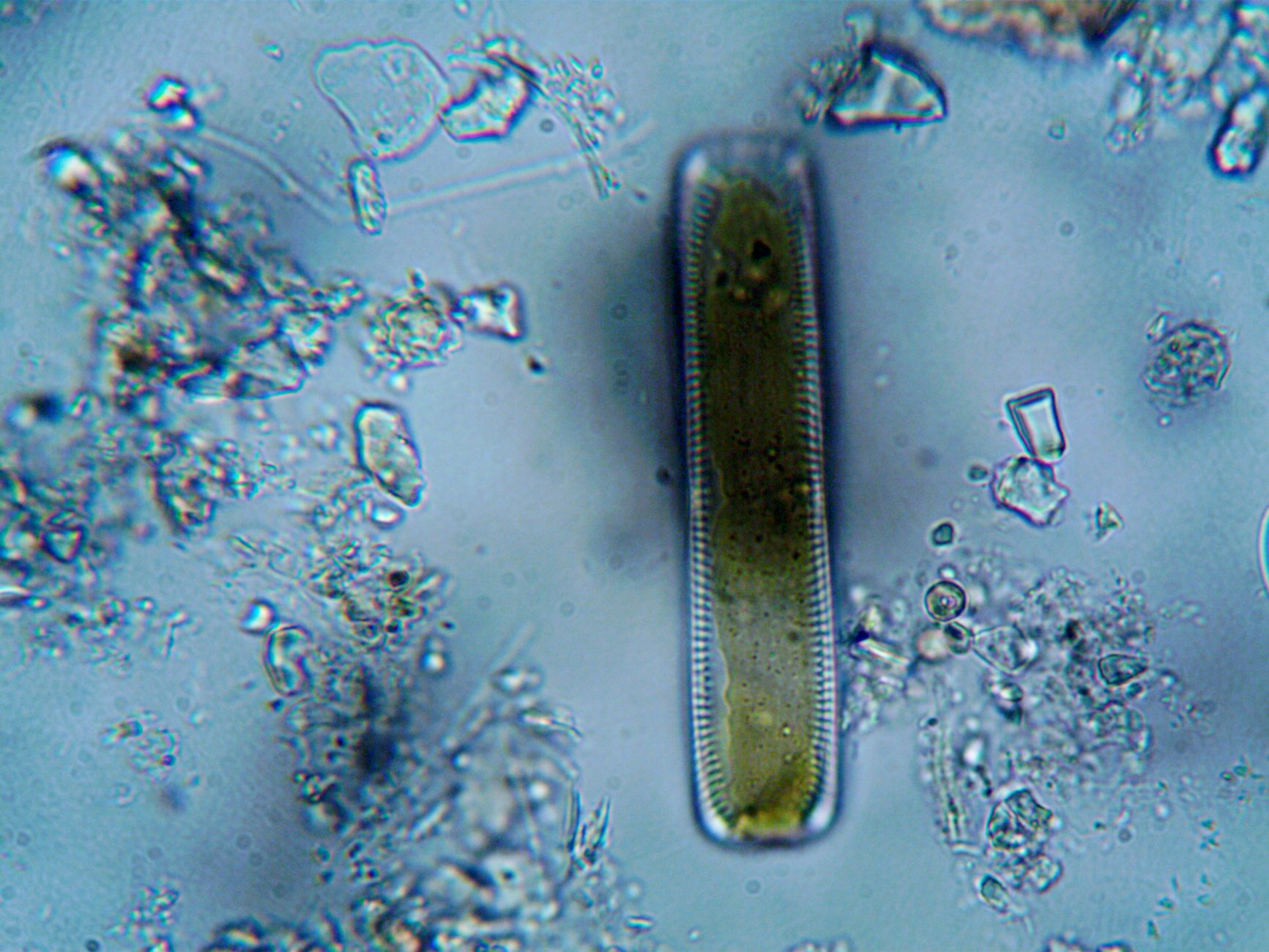
Chlamydomonas is a single-celled green alga that swims toward light. To do that, it needs to sense light and turn that sensation into action, fast. In the early 1990s, Hegemann was studying how it manages this, and he proposed something unusual: that a single protein might both capture light and act as an ion channel, catching a photon and opening a gate in the same motion. Nagel tested the idea in a clever way. He injected the alga's genes into frog eggs and identified channelrhodopsin-2, a channel that opens when light hits it. In 2003, the pair published work showing that the protein could be used in human and hamster cells to generate electrical impulses with light.
I had to read this part twice. According to STAT, the researchers found that the protein worked in any cell they injected it into. A light sensor that evolved to steer a microscopic swimmer could be borrowed by any other living cell, as long as that cell carried the gene.
From frog eggs to a living brain
That's where Deisseroth comes in. At Stanford, his lab put the channelrhodopsin gene into rat nerve cells, and in 2005 they published a paper whose title describes the whole idea: "Millisecond-timescale, genetically targeted optical control of neural activity." Shine blue light, and the neurons carrying the gene fired, with timing precise to the thousandth of a second. The method got its name, optogenetics, in 2006, and by 2007 the lab had shown it working in living mice.
The key word in that title is "genetically targeted." Because the channel arrives as a gene, scientists can deliver it to only one kind of neuron and leave the others untouched. Then, with a flash of light, they can switch on just those cells, or with related tools switch them off, and watch what the animal does. That was Crick's far-fetched wish, granted by an alga. Deisseroth summed up the shift in thinking to STAT: "We're not using light to collect information, we're using light to cause things to happen."
The results read like a tour of biology's biggest questions. One example caught my attention because of an earlier piece of mine: researchers used optogenetics to show that a group of neurons in the hypothalamus that make a signaling molecule called orexin drive the transition from sleep to wakefulness. Others have used it in the search for the memory engram, the physical trace of a single memory in the brain. Per Svenningsson, chair of the Nobel Committee, put it simply: "Optogenetics provides opportunities for mapping the brain in a way that we could once only dream of."
Promise, at the right strength
Medicine is the obvious next question, and here I want to keep the claims at exactly the strength the evidence supports. Svenningsson noted that optogenetics "has been used to partially restore vision in blind patients with retinitis pigmentosa," a disease that destroys the eye's light-sensing cells. Animal studies are exploring conditions from Parkinson's disease to epilepsy to addiction. But according to Reuters, the most advanced treatments in development are still some way from patients. For now, optogenetics is above all a research tool, one that laboratories around the world now use to ask questions about the brain.
It's also worth saying that a prize shared by three names never captures a whole field. STAT reported that many commentators thought Ed Boyden, the first author on that 2005 paper, should have been included, and other researchers ran related experiments in the same years. Science is a crowd, even when the medal goes to a few.
The case for curiosity
What stays with me is the order of events. Nobody studying how an alga swims was trying to map memory or treat blindness. They wanted to understand one small, beautiful behavior, and the answer turned out to be a key that fits locks in every animal brain. It's easy to ask what a piece of basic research is for. This prize is a reminder that the honest answer is often "we don't know yet," and that the most useful tools in medicine sometimes begin as a question about something swimming toward the light.
I spend most of this column on thresholds that don't negotiate and verbs that cost lives. This week I'm glad to report a different kind of mechanism: a gate that opens in the light, borrowed from an alga, now helping us read the most complicated object we know of. Follow the mechanism long enough, and sometimes it leads somewhere hopeful.